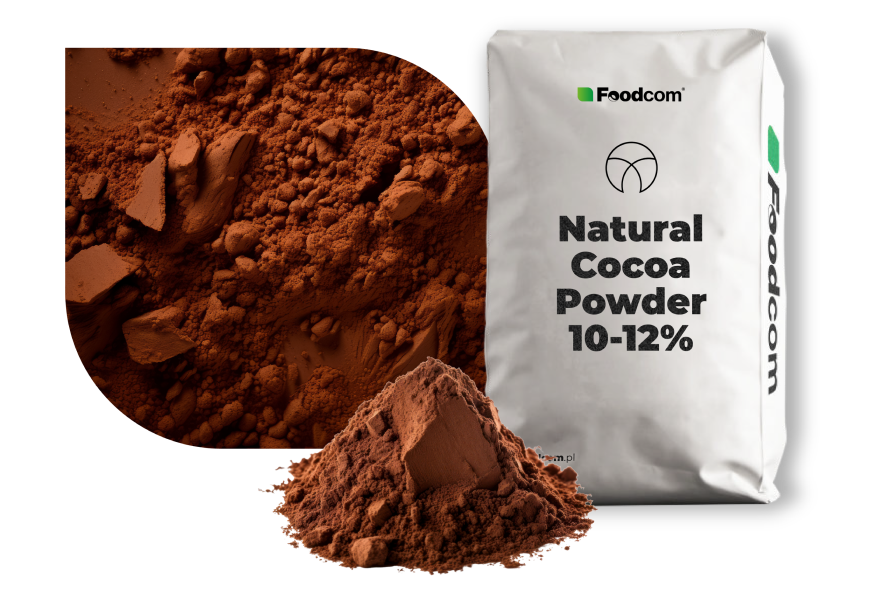
Natural vs Dutch vs Black Cocoa — What Changes at Every pH
Five cocoa types — five completely different formulation profiles. pH, fat, colour, polyphenol content, and leavening compatibility all shift dramatically between natural and alkalized process. Select a type to see the full specification.
🍫
Loading...
—
Fat %
—
pH
—
EBC Colour
—
Theobromine
—
Polyphenols
—
Moisture max
Formulation rule #1: Natural cocoa (acid, pH 5.2–5.8) requires baking soda (NaHCO₃) as leavening — the acid/base reaction produces CO₂. Dutch-process (neutral, pH 7–8.5) requires baking powder. Using the wrong type causes flat baked goods.
pH Impact Analysis
How pH Shapes Every Formulation Variable
The pH of cocoa powder — ranging from 5.2 in natural to 8.8 in black cocoa — is not a cosmetic specification. It governs six critical formulation variables simultaneously:
Colour (EBC): Alkalization pre-triggers Maillard-like browning in the cocoa itself, shifting colour from 50 EBC (light brown, natural) to 380 EBC (near-black, black cocoa) — a 7× colour range.
Polyphenol retention: The alkaline treatment at pH 7+ degrades epicatechin and procyanidins — the primary cocoa flavanols — by 50–70%. Natural cocoa retains ~100% of its antioxidant capacity; black cocoa retains ~25%.
Cold solubility: Natural cocoa particles are hydrophobic at pH 5.2. Dutch process neutralises surface charge, dramatically improving wettability in cold water — critical for RTD beverages and instant mixes.
Emulsion stability: At neutral pH, cocoa particles disperse more evenly in oil-in-water emulsions. Critical for chocolate RTD, ice cream bases, and protein shakes.
Key insight: There is no "best" pH — the right choice depends entirely on your application. Natural for polyphenol content, flavour intensity, and baking. Dutch for cold mixability, colour depth, and mild flavour.
pH vs. Formulation Properties (% of max, normalised)
Data based on published literature values (Wollgast & Anklam 2000; Dorenkott et al. 2014). EBC values normalised to 100% scale for comparison.
Polyphenol & Theobromine Profile
Cocoa vs 8 Comparison Sources — Full Nutritional Benchmark
Natural cocoa powder contains ~60 mg/g polyphenols (primarily epicatechin, catechin, and procyanidins B1/B2) and 1.8–2.2% theobromine. How does it compare to raw cacao, dark chocolate, carob, and cocoa nibs?
⚠ EU Health Claims: As of 2026, no approved EU health claim exists for cocoa flavanols (EFSA 2012 opinion). The US FDA allows a qualified health claim for cocoa flavanols and cardiovascular risk (2023). Do not make health claims on EU-sold products without EFSA approval.
Raw cacao vs cocoa powder: Raw cacao (~120 mg/g polyphenols) uses sub-45°C processing. Standard cocoa powder heat treatment (120–130°C) reduces polyphenol content by ~50%. "Raw" is not an EU-regulated term — verify by requesting polyphenol analysis (Folin-Ciocalteu method) from your supplier.
Application Matrix
Cocoa Powder in 6 Industrial Applications — Formulation Protocols
Natural vs Dutch, fat content, pH compatibility, dose range, and process parameters — for every relevant B2B application.
EBC Colour Guide
Cocoa Colour Scale — From Natural Light Brown to Black
The colour of cocoa powder is a direct proxy for its processing history. The EBC (European Brewery Convention) scale, typically used in brewing, is increasingly applied in the cocoa industry to standardise colour specifications. Understanding colour grade helps you:
Select the right grade for visual appeal in finished products
Align purchase specifications with supplier certificates
FDCM's Natural Cocoa 10–12% falls in the 50–90 EBC range — light to medium brown, with full polyphenol retention and maximum Maillard browning potential. Click each swatch for detailed formulation notes.
Note: For precise colour specification, request Lovibond measurement or CIE L*a*b* values from your FDCM contact. EBC is indicative — ISO 2291 colour measurement is the formal standard in the cocoa trade.
50–90
Natural
90–150
Nat 20-22%
150–220
Dutch Light
220–280
Dutch Med.
280–380
Black
Global Sourcing · EU Delivery
From Origin to Your Factory
FDCM sources natural cocoa powder from certified West African (Côte d'Ivoire, Ghana) and South American (Ecuador) origins. EU warehouse in Warsaw ensures 3–7 day delivery across all 27 member states.
Raw cacao and natural cocoa powder are often confused. The distinction is processing temperature — and it has significant implications for nutritional profile, food safety, and regulatory labelling.
Parameter
Natural Cocoa Powder (FDCM)
Raw Cacao Powder
Processing temp
120–130°C (standard drying)
Claimed <45°C
Polyphenols
~60 mg/g (Folin-Ciocalteu)
~95–120 mg/g (variable)
ORAC value
~45,000–75,000 µmol TE/100g
~95,000–125,000 µmol TE/100g
Theobromine
1.8–2.2%
2.0–2.5%
EU regulatory status
Food ingredient per Dir. 2000/36/EC
No specific EU definition — varies
Microbiological safety
Controlled — heat kills pathogens
Higher risk — Salmonella possible
Shelf life
24 months typical
12–18 months (oxidation faster)
Price (typical EU)
Lower — industrial process
Premium — 2–4× higher
Leavening compatibility
Requires baking soda (NaHCO₃)
Same — also acidic pH
Cadmium testing
Mandatory per Reg 2023/915
Same regulation applies
Food safety note: Low-temperature processing in raw cacao powder does not eliminate Salmonella or other pathogens. FDCM's standard cocoa powder is heat-treated at 120–130°C — equivalent to pasteurisation for bacterial safety. For high-risk applications (infant food, medical nutrition), always verify microbiological CoA regardless of raw vs processed designation.
Safety & EU Regulatory
Full Regulatory Status — Cadmium, OTA, Microbiological & More
Cocoa powder is subject to specific EU regulations on heavy metals (Cd, Pb), mycotoxins (Ochratoxin A), and microbiological criteria. FDCM provides batch CoA covering all mandatory parameters.
Parameter
EU Regulation / Standard
Status
EU Status
Cocoa powder: food ingredient per Regulation (EC) 178/2002. No E-number — listed as 'cocoa powder (natural)' or 'fat-reduced cocoa powder'. Quantum satis in all categories.
✓ OK
Heavy Metals EU
Cadmium: ≤0.60 mg/kg (Reg 2023/915 for cocoa powder with fat <20%). Lead: ≤0.10 mg/kg (Commission Reg 2021/1317). Testing mandatory each lot.
✓ OK
Ochratoxin A
OTA limit: ≤3 µg/kg in cocoa powder (Reg EC 1881/2006 amend. 2021/1399). Batch CoA must confirm. FDCM sources from certified suppliers with OTA testing.
✓ OK
Allergens
Cocoa powder: NOT listed in EU 14 major allergens (Reg EU 1169/2011). Risk: may contain tree nuts, milk (cross-contamination) — CoA must declare.
✓ OK
Theobromine
Theobromine content: 1.4–2.5% in natural cocoa. EFSA opinion: safe at normal consumption. Declare in nutraceuticals. NOT for dog/cat food — toxic to monogastrics.
⚠ Note
Pesticide Residues
MRL compliance: Annex IV of Regulation (EC) 396/2005. Key monitored: chlorpyrifos, glyphosate. Certified organic suppliers available on request.
Not Novel Food — historical use in EU food supply. Cocoa extracts with >10% flavanol may require Novel Food assessment.
✓ OK
⚠ Critical — Cadmium (EU Reg 2023/915): From January 2025, the cadmium limit for cocoa powder (fat <20%) is ≤0.60 mg/kg. FDCM provides cadmium test results with every batch. West African origins (CIV, Ghana) typically comply comfortably; South American origins (Ecuador, Peru) require closer monitoring. Request current batch CoA before purchase.
FAQ — 17 Deep-Technical Questions
Natural Cocoa Powder — B2B Buyer's Complete FAQ
From pH and Maillard browning to cadmium regulations and fat bloom — answers written for food technologists, product developers, and procurement managers.
Natural cocoa powder (pH 5.2–5.8) retains the original acidity from fermentation — this gives it a more intense, complex chocolate flavour and higher polyphenol content (~60 mg/g). Dutch-process (alkalized, pH 7.0–8.5) has been treated with potassium carbonate (K₂CO₃), which neutralises the acid, deepens the colour to dark brown/mahogany, improves cold solubility, and reduces polyphenol content by 50–70%. The choice has direct formulation consequences: natural cocoa requires baking soda (NaHCO₃) as leavening agent due to its acidity; Dutch-process requires baking powder. Using the wrong type is the most common baking error with cocoa.
Yes — the percentage refers to cocoa butter (fat) content. Natural Cocoa 10–12% contains 10–12% residual cocoa butter after pressing. Natural 20–22% contains twice the fat, resulting in richer mouthfeel, better emulsification, and higher caloric density. FDCM's standard product is Natural Cocoa 10–12%, suitable for the widest range of industrial applications including protein powders, baked goods, and beverages. The 20–22% fat variant is available upon request for premium formulations.
Cold solubility is largely a pH and particle size issue. Natural cocoa (pH 5.2–5.8) has hydrophobic particle surfaces at low temperature — it disperses poorly in cold water without mechanical agitation. Dutch-process cocoa (pH 7.0–8.5) disperses significantly better in cold water due to the neutral pH improving particle wettability. Solutions: (1) Use Dutch-process for cold-mix beverages; (2) Add lecithin (0.2–0.3%) as wetting agent; (3) Homogenise at 60–65°C then cool; (4) Use CMC or xanthan gum (0.05–0.1%) to keep particles suspended.
FDCM's Natural Cocoa 10–12% contains approximately 1.8–2.2% theobromine (18–22g per kg). At typical use levels (8–12% in protein powder, or 15–20% in baked goods), the finished product contains 150–440 mg theobromine per 100g — comparable to 1–2 squares of dark chocolate. EFSA's 2008 scientific opinion found no adverse effects at these intake levels in humans. Important: theobromine is toxic to dogs and cats (cannot metabolise methylxanthines). Do not use cocoa powder in pet food.
ORAC (Oxygen Radical Absorbance Capacity) measures antioxidant activity. Raw cacao powder reaches 95,000–125,000 µmol TE/100g. FDCM's Natural Cocoa 10–12% typically shows 45,000–75,000 µmol TE/100g (heat treatment during drying reduces activity vs raw). For comparison: blueberries ~4,500, goji berries ~25,000, acai powder ~102,700. The key active compounds are flavanols (primarily epicatechin, catechin, and procyanidins). Note: ORAC is not an approved basis for EU health claims.
Yes — natural cocoa powder (pH 5.2–5.8) is compatible with WPC 80 (pH 5.8–6.2) and casein (pH 6.0–7.0). At 8–12% cocoa in a blend, protein solubility remains unaffected. Key consideration: Dutch-process cocoa (pH 7.0–8.5) at high concentrations (>15%) can shift the blend pH above 7.0, which may affect casein micelle stability under heat processing. For RTD protein beverages requiring UHT treatment, use Dutch-process at ≤8% and verify pH of the final mix before heat treatment.
EU Regulation 2023/915 (amended from Reg 488/2014) sets cadmium limits for cocoa powder at ≤0.60 mg/kg (for products with fat content <20%). This limit applies from 1 January 2025. FDCM requests Cd testing for every production batch — certificates of analysis are available on request. Cadmium content in cocoa varies significantly by origin: South American origins (Ecuador, Peru) tend to be higher; West African (Côte d'Ivoire, Ghana) typically lower. Our standard source is West African certified product.
Store at 15–20°C, relative humidity ≤65%, away from light and odorous materials. Cocoa powder is hygroscopic — exposure to moisture above 65% RH causes clumping and accelerates mould growth. Polyphenol oxidation is catalysed by light and heat above 25°C. Recommended packaging: multi-layer paper bags with polyethylene inner liner (25 kg standard). Shelf life: 24 months from production date in sealed original packaging. After opening, seal immediately and use within 3 months.
Processing temperature is the key distinction. Cocoa powder is made from cocoa liquor that has been pressed (removing most fat) and then heat-treated at 120–130°C during drying. Raw cacao powder is processed at temperatures claimed to remain below 45°C — preserving more heat-sensitive polyphenols. As a result, raw cacao contains ~120 mg/g polyphenols vs ~60 mg/g in cocoa powder. However, 'raw' is not a regulated EU term — there's no legal definition, and polyphenol levels vary widely between raw products. FDCM sells food-grade natural cocoa powder per EU Cocoa Directive 2000/36/EC.
Yes, but in small quantities relative to theobromine. Natural Cocoa 10–12% contains approximately 0.1–0.3% caffeine (1–3g per kg powder), compared to 1.8–2.2% theobromine. At an 8% inclusion in protein powder, a 30g serving would contain ~24–72mg caffeine — equivalent to roughly 1/4 to 3/4 cup of coffee. Theobromine has a longer half-life than caffeine (~7 hours vs 3–5 hours) and provides sustained, mild stimulant effects. Both compounds should be declared in nutraceutical applications.
Yes — cocoa powder is an approved feed material under EU Regulation 767/2009 (Catalogue of feed materials, annex V). It can be used in ruminant, pig, and poultry feeds. Critical restrictions: (1) Theobromine must be declared when >0.1% in finished feed; (2) Do NOT use in companion animal (dog/cat) feeds — theobromine toxicity; (3) In poultry, limit to ≤3% due to theobromine sensitivity. A typical application is as a palatability enhancer in dairy cow TMR at 2–5% inclusion level.
Fat bloom is the formation of a white/grey crystalline layer on chocolate or cocoa-containing surfaces, caused by cocoa fat (primarily stearic acid, C18:0, and oleic acid, C18:1) migrating to the surface and recrystallising into Form VI beta crystals. In cocoa powder products: 20–22% fat cocoa carries significantly higher bloom risk than 10–12% fat, especially above 22°C storage. Prevention: (1) Store below 20°C; (2) Temper products containing high-fat cocoa at 28–32°C before cooling; (3) Use 10–12% fat cocoa in applications stored at ambient temperature.
Our standard Natural Cocoa 10–12% is suitable for Halal and Kosher use from a raw material perspective — cocoa powder contains no animal-derived ingredients. Formal Halal/Kosher certification (JAKIM, KOF-K, or equivalent) requires documentation from the specific production lot. Please request this documentation when placing your order. Note: cross-contamination risks at manufacturing facilities (e.g., with milk) need to be assessed from supplier CoA.
Standard specification: D50 approximately 50–75 μm, with residue on 75 μm sieve ≤3%. This is the standard commercial grind suitable for all beverage, protein, and baking applications. Finer grinds (D50 < 20 μm) are available for pharmaceutical or premium cosmetic applications on request. Particle size affects: dispersion rate in beverages (finer = faster), texture in baked goods (finer = smoother), and surface area for flavour release. Bulk density: approximately 450–550 g/L (tamped).
Alkalization (Dutch-process, pH adjustment to 7.0–8.5 using K₂CO₃) significantly impacts several nutritional parameters: Polyphenols reduced 50–70% (epicatechin and procyanidin degradation). Theobromine: reduced ~15–20%. ORAC value: drops from ~60,000 to ~20,000–35,000 µmol TE/100g. Minerals (Mg, Fe, Zn) remain largely unchanged. Protein: unaffected (~18–20% in 10-12% fat cocoa). If health benefits or polyphenol claims are important for your product, natural process cocoa is the clear choice. Dutch process is chosen for colour, solubility, and mild flavour.
Minimum order: 1 bag = 25 kg (standard EU industrial packaging, multi-layer paper bag with PE inner liner). No contract required, no volume commitment. Larger quantities: available on pallets (typically 20 bags = 500 kg per pallet) and full truck loads (20,000–24,000 kg). Pricing is per-kg and scales with volume. Delivery across EU-27 via DSV logistics, typically 3–7 business days from order confirmation. Contact contact@fdcm.eu with your required specification (natural/Dutch, fat content) for current pricing.
The EBC (European Brewery Convention) colour scale is sometimes used in the confectionery and chocolate industry to specify cocoa powder colour, though ICCO and ISO 2291 (visual colour grade) are more standard in the cocoa trade. EBC values for cocoa powder: Natural 10–12%: 50–90 EBC (light to medium brown). Dutch 10–12%: 150–280 EBC (dark brown to mahogany). Black cocoa: 280–380 EBC (near-black). Higher EBC values correlate with increased alkalization degree. For standardised colour specification, FDCM can provide Lovibond or L*a*b* colour data on request.
References: EFSA 2008 (theobromine safety); Wollgast & Anklam 2000 (cocoa polyphenols); EU Reg 2023/915 (cadmium limits); Dir. 2000/36/EC (cocoa products); Reg 767/2009 (feed materials); Reg 2073/2005 (microbiological criteria). Content prepared for food industry B2B buyers. Not a substitute for laboratory analysis of specific production lots.
Request a Quote for Natural Cocoa Powder
25 kg minimum · EU warehouse · No contract · Cadmium CoA included · DSV EU-27 delivery in 3–7 days